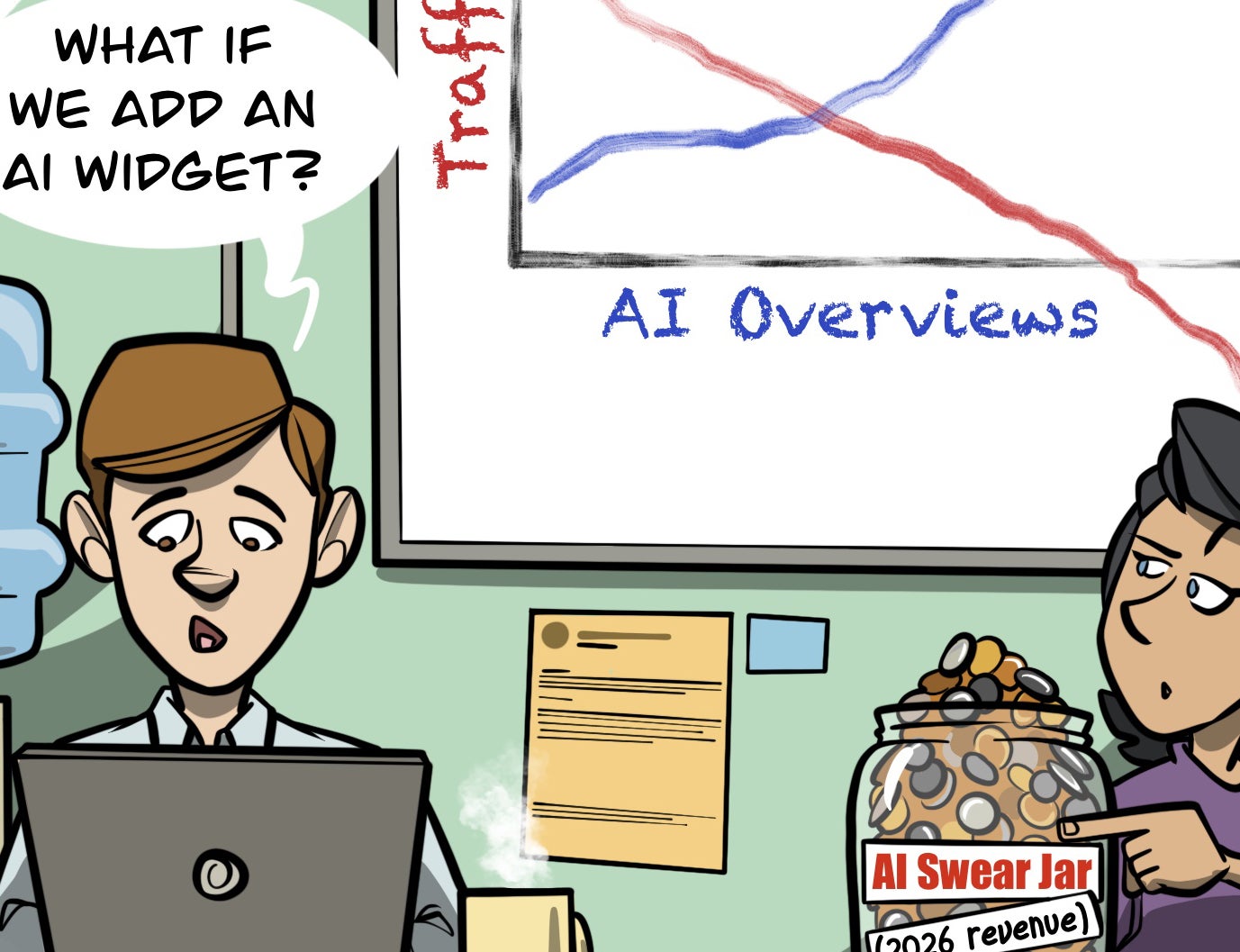
HubSpot Loses 80% Of Traffic But Revenue Keeps Growing
HubSpot's revenue continued to grow despite losing 80% of its organic traffic due to AI answers, according to CMO Kipp Bodnar. The company's diversification of channels and focus on quality traffic contributed to its revenue growth.
Original reporting · searchenginejournal.com
Original: “HubSpot Lost 80% Of Its Traffic – CMO Kipp Bodnar Explains Why Revenue Kept Growing via @sejournal, @gregjarboe”
Read “HubSpot Lost 80% Of Its Traffic – CMO Kipp Bodnar Explains Why Revenue Kept Growing via…” at Search Engine Journal →
How this was written. The 5:45 wrote this article with a language model from Search Engine Journal’s reporting (model: @cf/meta/llama-3.3-70b-instruct-fp8-fast); it describes that reporting rather than adding to it. The original, linked above, is the full story.
Key points from Search Engine Journal’s report
- HubSpot lost 80% of its organic traffic due to AI answers, but revenue continued to grow.
- The company's diversification of channels, including acquisitions and new programs, contributed to its revenue growth.
- HubSpot's new approach to marketing, Loop Marketing, involves a four-stage process to create a personalized experience for each buyer.
- The company reported promising results from testing Loop Marketing on its own marketing engine, including an 82% improvement in conversions for AI-powered emails.
- The future of marketing is likely to involve a continued shift towards AI-driven approaches, with a focus on data and personalization.
HubSpot, a well-known marketing software company, experienced a significant decline in organic traffic, losing about 80% of its monthly visits, according to Search Engine Journal. This decline was largely due to the rise of AI answers, which reduced the need for users to visit the company's website. However, despite this loss, HubSpot's revenue continued to grow, with a nearly 20% increase in 2025.
The company's ability to maintain revenue growth despite the decline in traffic can be attributed to its diversification of channels, including the acquisition of The Hustle newsletter, the launch of a creator program, and the development of a podcast and YouTube network. These channels, which did not exist or were minimal five years ago, now account for about 90% of HubSpot's content leads, with the blog accounting for only about 10%.
CMO Kipp Bodnar explained that the company's old traffic was not entirely valuable, with some posts attracting visitors who would never buy software. The introduction of AI Overviews led to a decline in traffic, but the visitors who still arrived at the website were more valuable, converting at roughly three times the rate of traditional search traffic.
Bodnar also discussed the company's new approach to marketing, which he calls Loop Marketing. This approach involves a four-stage process, including Express, Tailor, Amplify, and Evolve, which feed into each other to create a continuous cycle of improvement. The goal of Loop Marketing is to create a personalized experience for each buyer, using data from real customer interactions to inform the marketing strategy.
The Loop Marketing approach has been tested by HubSpot on its own marketing engine, with promising results. The company reported an 82% improvement in conversions for AI-powered emails personalized to each recipient, and an average 50% increase across the broader email program. However, Bodnar acknowledged that the results are based on the company's own metrics and may not be directly applicable to other businesses.
Bodnar's account of HubSpot's experience provides valuable insights for SEO professionals and marketers, highlighting the importance of diversifying channels and focusing on quality traffic. The company's willingness to experiment and adapt to changing market conditions has enabled it to maintain revenue growth despite the decline in organic traffic.
The future of marketing is likely to involve a continued shift towards AI-driven approaches, and companies like HubSpot are at the forefront of this trend. As Bodnar noted, the mechanism of marketing has broken, but marketing itself has not. The key to success will be to find new ways to reach and engage with customers, using data and personalization to create a more effective marketing strategy.
Questions and answers
What happened to HubSpot's organic traffic?
HubSpot lost about 80% of its organic traffic due to the rise of AI answers.
How did HubSpot maintain revenue growth despite the decline in traffic?
The company diversified its channels, including acquisitions and new programs, and focused on quality traffic, which contributed to its revenue growth.
What is Loop Marketing, and how does it work?
Loop Marketing is a four-stage process that involves Express, Tailor, Amplify, and Evolve, which feed into each other to create a continuous cycle of improvement, using data from real customer interactions to inform the marketing strategy.